




Introduction
In the world of sustainable fashion, certifications are the language of trust. However, for many sourcing managers, the difference between GOTS (Global Organic Textile Standard) and OEKO-TEX Standard 100 can be confusing. Are they interchangeable? Or does your brand need both? In this guide, we break down the core differences to help you choose the right verified partners from our global directory.
1. GOTS: The Gold Standard for Organic Integrity
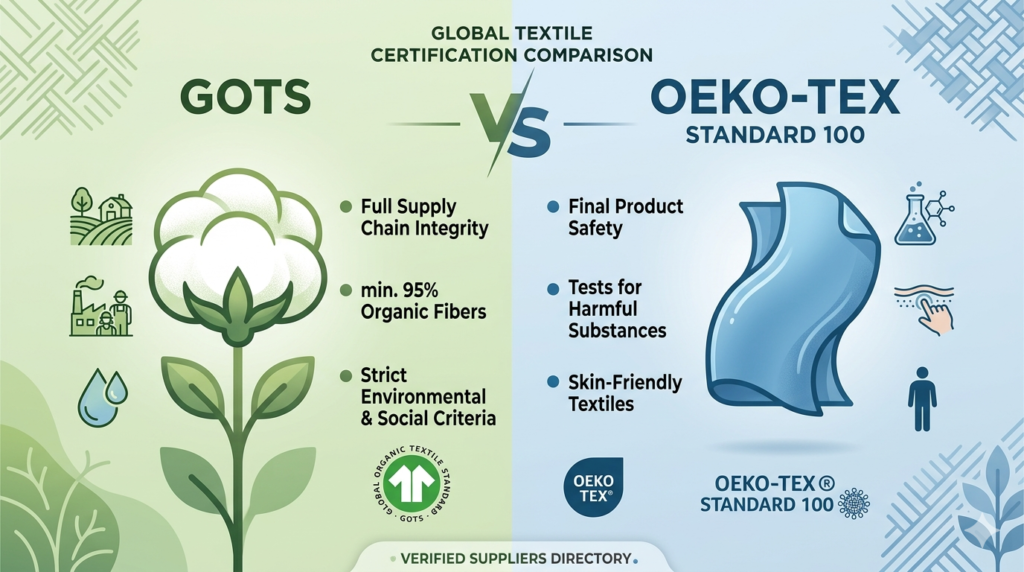
GOTS is the world’s leading processing standard for organic fibers. It doesn’t just look at the final product; it monitors the entire supply chain.
- The Scope: From harvesting raw materials to environmentally and socially responsible manufacturing.
- The Requirement: To carry the GOTS “Organic” label, a product must contain at least 95% certified organic fibers.
- Social Criteria: Unlike many other standards, GOTS includes strict compliance with International Labour Organization (ILO) standards, ensuring fair wages and safe working conditions.
2. OEKO-TEX: Safety and Chemical Testing
OEKO-TEX Standard 100 focuses primarily on the safety of the final product and its effect on human health.
- The Scope: It tests for harmful substances (pesticides, heavy metals, formaldehyde) in every component—including buttons, zippers, and linings.
- Organic vs. Conventional: A product can be OEKO-TEX certified even if it is made from conventional (non-organic) cotton, as long as it is chemically safe for the consumer.
3. Key Differences at a Glance
| Feature | GOTS | OEKO-TEX Standard 100 |
| Organic Content | Mandatory (min. 70-95%) | Not Required |
| Supply Chain Traceability | Full (Farm to Factory) | Final Product Focus |
| Social Standards | Strict ILO Compliance | Not the Primary Focus |
| Chemical Safety | Extremely Strict | High (Consumer Safety) |
4. Which One Should You Choose?
- Choose GOTS if your brand identity is built on environmental sustainability and ethical sourcing. It is the ultimate proof that your product is truly “organic.”
- Choose OEKO-TEX if your priority is consumer skin safety and ensuring that no toxic residues remain in your garments, regardless of the fiber’s origin.
Conclusion: The Power of Dual Certification
For leading global brands, the most resilient supply chain often involves manufacturers who hold both GOTS and OEKO-TEX certifications. This ensures that the fabric is both environmentally organic and chemically safe for the end-user.
